
The Future of Data Scraping in Retail, Ecommerce & Food — AI, Ethics & the DataGrass Intelligence Layer
The Future of Data Scraping in Retail, Ecommerce & Food — AI, Ethics & the DataGrass Intelligence Layer
By 2026, data scraping has evolved from a tactical engineering task into a strategic intelligence layer that powers modern commerce.
Retail, ecommerce, and food delivery sectors are no longer just gathering data — they’re activating it.
At the center of this transformation is DataGrass, an AI/ML infrastructure that enables brands to turn scraped, behavioral, and transactional data into real-time intelligence—ethically, efficiently, and profitably.
That’s where platforms like DataGrass come in: we transform raw data into actionable intelligence through a unified AI/ML infrastructure.
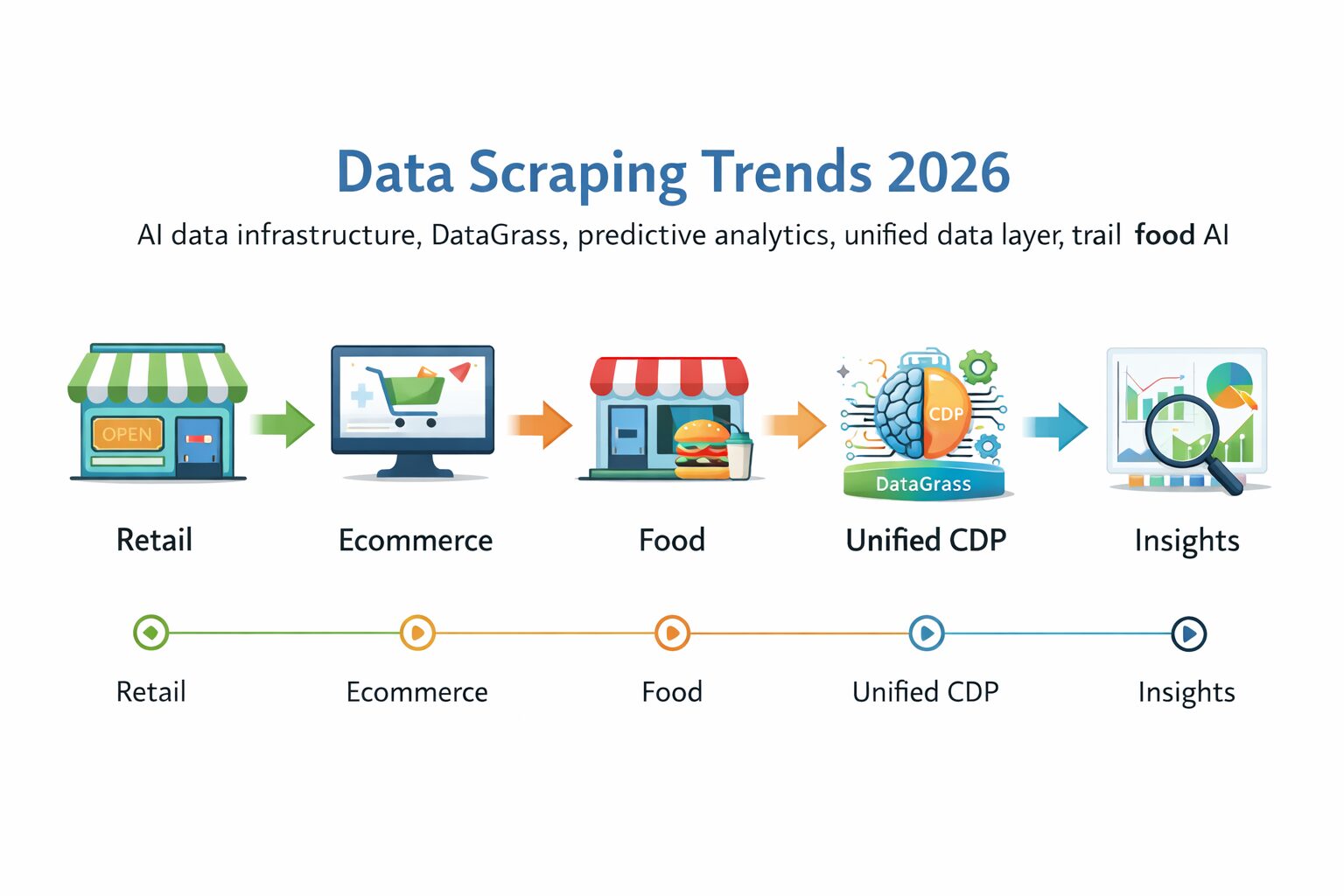
From Scraping to Strategic Intelligence
In the early days, scraping was about volume — collecting as much data as possible.
Today, the focus is on meaningful integration: connecting competitor data, customer actions, and campaign performance into a single real-time insights system.
AI models now:
Understand context (not just content).
Predict behavioral shifts in customers.
Trigger automated actions such as personalized pricing, offers, or recommendations.
DataGrass acts as the bridge between these worlds, combining data collection, real-time event streaming, and AI-driven decision systems.
Emerging Trends Defining Data Scraping in 2026
Trend 1: Autonomous AI-Scrapers
AI models now adapt scraping logic automatically when site structures change — no more manual rule updates.
DataGrass’s infrastructure uses ML-driven scrapers that continuously learn DOM patterns and prevent downtime.
Trend 2: Unified Data Infrastructure
DataGrass integrates scraped datasets with CRM, POS, and event streams — creating a Customer Data Platform (CDP)with unified, AI-enriched profiles.
Trend 3: Real-Time AI Consumption
With a streaming API layer, DataGrass feeds scraped and behavioral data directly into AI engines — supporting predictive demand, pricing, and personalization models.
Trend 4: Predictive Analytics as Default
Historical export capabilities within DataGrass allow ML engineers to train and refine models that forecast market demand, user churn, and optimal pricing points.
Trend 5: Dynamic Segmentation
The segmentation engine continuously updates cohorts based on recency, frequency, and spend—a critical shift from static databases to AI-evolving audiences.
Retail Use Cases Enhanced by DataGrass
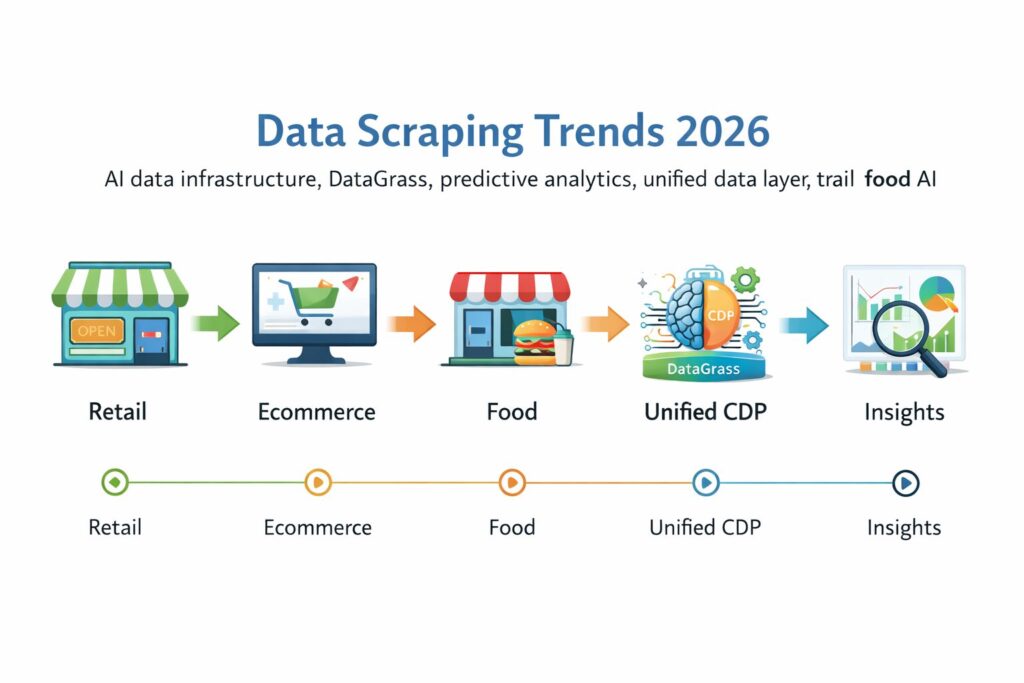
Retail
Predict demand surges and automate pricing via competitor scraping and real-time behavioral data.
Ecommerce
Build adaptive pricing and reward systems with continuous feedback from AI-driven analytics.
Food Delivery & Aggregators
Launch segmented loyalty campaigns for cloud kitchens and restaurants, targeting high-value or dormant users with precise offers.
Across all three, DataGrass provides a single, secure infrastructure layer that reduces data silos and unifies decision-making.
The Strategic Payoff for Founders & Executives
Speed to insight: from raw HTML to AI-ready data in minutes.
Operational efficiency: eliminate manual data prep, reduce integration overhead.
Revenue growth: activate personalized campaigns, pricing, and loyalty at scale.
Cross-domain scalability: same AI pipelines work across retail, ecommerce, and food data sources.
The outcome?
A continuous cycle of intelligence → activation → optimization — powered by the DataGrass AI/ML infrastructure.
Conclusion
The future of data scraping isn’t about scraping more — it’s about scraping smarter.
By merging AI automation, ethical data practices, and cross-industry intelligence, DataGrass empowers businesses to move beyond dashboards into a new era of autonomous decision systems.
Retailers, e-commerce leaders, and food aggregators that embrace this shift will not only outpace competitors but also own the future of data-driven growth.